

 REQUEST FOR QUOTATION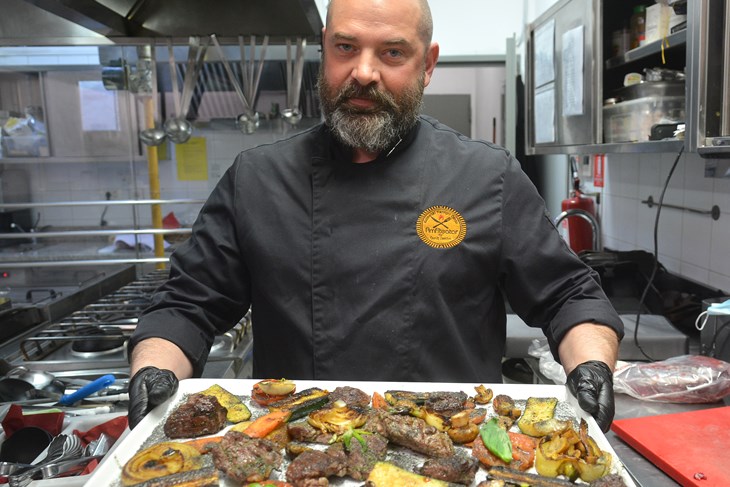
Pula hotel and restaurant run by renowned Croatian chef becomes the FIRST AND ONLY IN ISTRIA TO RECEIVE HALAL CERTIFICATE
The renowned Hotel Amfiteatar in Pula has been awarded the prestigious halal quality certificate, making it the only hotel in Istria to hold this certification. The certificate was presented to the hotel’s chef and owner, Deniz Zembo, by Aldin Dugonjić, head of the Croatian Centre for Halal Quality Certification in Zagreb. This is a specialised institution of the Islamic Community and the only authorised body in Croatia for issuing halal certificates, with education about halal as its core activity. For a restaurant to obtain a halal certificate, it is necessary to align its service with Islamic regulations and halal quality standards.
Aldin Dugonjić, head of the Centre and an expert on halal nutrition, published the book “Halal, a Standard Tailored to Man” on this topic two years ago. He explained to us in more detail the significance of this certificate for hospitality establishments and their guests.
“The halal certificate confirms that Hotel and Restaurant Amfiteatar offers services in accordance with the halal standard. Namely, the dishes and beverages prepared here must be made from ingredients that are halal, which means that during food preparation care must be taken to avoid mixing with food that is not in accordance with the regulations, i.e. not halal,” explains Dugonjić.
As for the hotel rooms, Dugonjić notes, they are equipped with elements needed by persons of the Islamic faith, such as a sajjada, a floor mat that Muslims use for prayer. If a room has a minibar, alcohol is removed from it. Staff education is also an essential element.
“Along with education and additional control of ingredients, the level of service quality is raised,” explains Dugonjić, adding that regular announced and unannounced inspections are then carried out to maintain quality continuity. What is important, he says, is that everyone is accountable to the end guest, both the certificate issuers and the service providers.
Dugonjić points out that Hotel Amfiteatar is currently the only hotel in Istria with a halal quality certificate, which is a major advantage given that the halal tourism market is developing more and more each year. He also says that, despite the crisis caused by the pandemic, the halal market continues to grow.
“We have been working on the development of halal tourism for about ten years, and we believe this will also contribute to a new sustainable tourism development strategy. We are pleased that Hotel Amfiteatar, led by Deniz Zembo, has completed this process, and that we will have one more service on offer in the tourism market, in addition to everything Istria already provides. For a travelling guest, the most important things are what they will see at a destination and what they will eat. A halal guest does not differ in any way from other guests; they also want to see all the beauties of Istria, except that they pay attention to the type of diet, but that is also the case with those seeking vegetarian or gluten-free diets. With this certificate, we have certainly made it easier for a guest seeking halal to make a choice,” Dugonjić notes.
Chef Zembo also expressed satisfaction with the received certificate, saying that this recognition is a continuation of the idea that restaurant chefs should become familiar with all types of diets and then have them at their fingertips.
“Given that we are already engaged in chef education within our Hotel Amfiteatar and the Culinary Development Centre, we decided on this additional training as well. I am in favour of lifelong learning, so this is another plus for us in terms of knowledge, ingredient management, and dish preparation. Likewise, this opens the possibility of having a new type of clientele who would come specifically on excursions to us, and we would provide them with food according to their standards, guaranteeing that we will not violate their customs,” Zembo states.
He also explained the characteristics of halal nutrition, which, he says, in free translation can mean humane treatment of animals during slaughter.
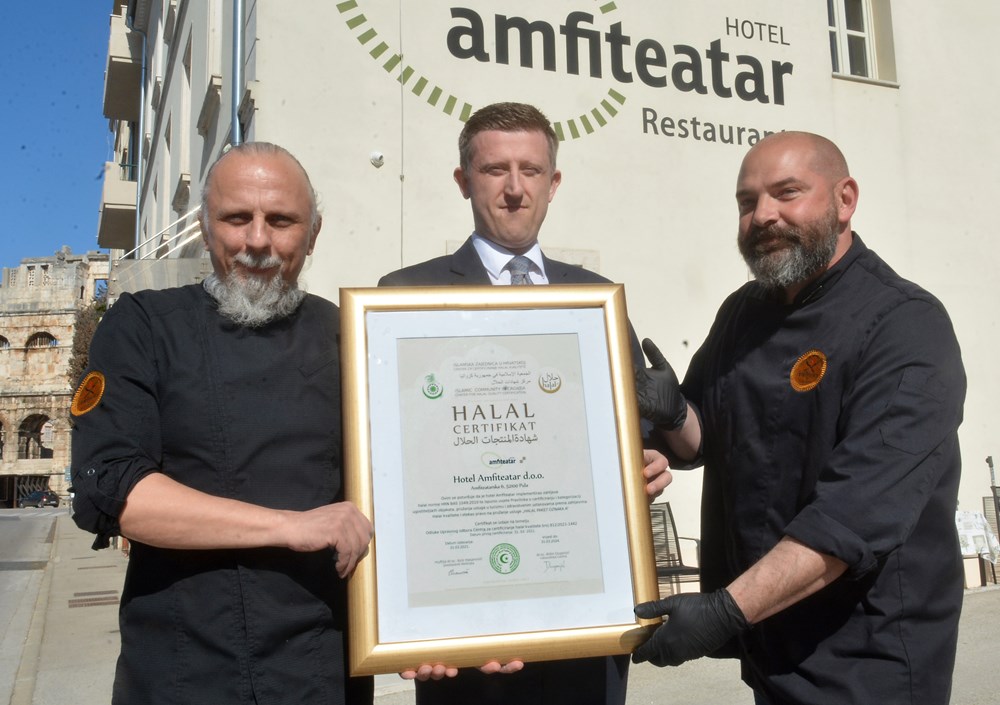
The hotel owner, renowned chef Deniz Zembo (first from left), was presented with the certificate by Aldin Dugonjić (centre) from the Centre for Halal Quality Certification (Photo by Danilo Memedović)
“Halal means a different way of preparing dishes: from slaughter, draining blood from ingredients, storage, distribution, and use. This does not allow the animal to release cortisol – the stress hormone – during slaughter, which spoils the quality of the meat, making it more acidic in taste and shorter-lasting. From a gastronomic perspective, it was also interesting for us to try what the difference in taste in the meat is. And you can really feel it,” Zembo confirms.
So that it would not remain just words, Deniz Zembo and Damjan Bistričić demonstrated dishes according to halal recipes and served guests ribeye and beefsteak prepared on the grill with various vegetables. Meat according to halal standards was supplied by their partner Produkt Komerc from Pazin, the first slaughterhouse in Croatia certified for the halal standard since 2012.
[ppl-ai-
“They supply us with our entire meat assortment and have proven to be excellent partners. Namely, within three days they enabled us and prepared what we requested. If we have a request for this type of diet, we can immediately obtain meat locally from Pazin. That made our dish preparation much easier. Then we prepare the dishes without any tricks. It is important that the original taste of the meat is felt – without added spices and sauces,” Zembo notes. He adds that their next step is obtaining a kosher certificate, which confirms food production in accordance with Jewish regulations.
Last year, Dugonjić points out, there was a particularly interesting case especially with Istria. He says that demand for halal ingredients increased precisely on the Peninsula, and this was due to the pandemic.
“All those who live in the European Union, and who otherwise travelled to countries like Turkey, would now come to Istria and seek halal-type food. This is just one indicator of the emitting market, that there is a very large number of consumers there and there is demand for such a service. The potentials and possibilities are enormous, and we are trying, in cooperation with all tourism stakeholders, to expand the number of halal service providers,” Dugonjić notes.
He emphasises that guests who come to establishments with such a certificate are always delighted. And that, he says, is their goal – that the guest receives a service about which they will have no doubts, that they feel comfortable and satisfied, and that they recommend the service to others.
We could not develop halal tourism if we had not first developed halal-certified production, i.e. certified ingredients for food preparation. Almost all food brands in Croatia have such a certificate, and according to a recently conducted survey, we found that over 50 percent of manufacturers with a halal certificate have increased their exports.
Source: [https://www.glasistre.hr/gastro/pulski-hotel-i-restoran-koji-vodi-poznati-chef-prvi-i-jedini-u-istri-dobio-halal-certifikat-713273](https://www.glasistre.hr/gastro/pulski-hotel-i-restoran-koji-vodi-poznati-chef-prvi-i-jedini-u-istri-dobio-halal-certifikat-713273)
- Log in to post comments